Jericho - Did the Wall Really Come Down?
- Dec 8, 2020
- 5 min read
Updated: Jan 11, 2021

Critics of the Bible will often say that the Bible is a book of fairytales - a book containing imaginary stories. This statement could not be farther from the truth. If you’re a skeptic yourself, I encourage you to bear with me and allow me to explain what I mean.
It is true that there are supernatural occurrences, or works of God, included in the text. It is also true, however, that in the Bible there are locations given, people named, events described, and time and time again it has been discovered that many of these Biblical claims are true and are consistent with archaeological and historical findings.
John Adams - second President of the United States - once said “Facts are stubborn things.” Facts cannot be argued with. There is no grey area when it comes to a fact. There is no emotion when it comes to proving or disproving a fact. No bias. No preference. Either something is true, or it’s not. So, as I wrote about my Jericho research, I stayed away from the findings that are disputed among archaeologists. I wasn’t interested in trying to formulate a defense with indeterminate findings, and instead I stuck with facts.

Those who know me know that I love History and Archaeology. Particularly History and Archaeology that authenticates Biblical accounts. A name for this is extrabiblical evidence, or simply put, evidence that is outside of the Bible. Lately, I have been researching the city of Jericho. My research started out as part of a more broad study into why the Bible can be trusted, but there was so much information on the city that was in line with the Bible that I ultimately decided to give Jericho its own article.
What is Jericho? What happened there? Can any of the Biblical claims be proven? Does Jericho even exist?
Jericho
Well, yes. Jericho does exist. Jericho is a city located in Israel. It is in the Jordan Valley and has very rich and fertile soil 1. The location was a prime choice for a city to have been established, due to the water source and fertility of the land. Surrounding this valley, the land is primarily a desert. Jericho is one of the oldest settlements with continuous inhabitants, and is still inhabited today.

The Biblical Account
One of the most dramatic stories told in the Bible was when the walls of Jericho fell. The Israelites were told to march around the city for six days with no noise, and on the seventh day they were to blow trumpets and shout. If they obeyed, the wall would fall down and they could invade the city. (Joshua 6:2-5)
The Bible also gives us more details. It tells us that Jericho was near the Dead Sea (Joshua 3:16), that it was a walled city (Joshua 6:5), the walls of the city fell (Joshua 6:20), it was a quick capture of the city (Joshua 6:3-5), and then Jericho was burned (Joshua 6:24).
These are some pretty specific claims. There is a location given, a rough amount of time to capture the city provided, and details of what the destruction was like. But does archaeology corroborate these claims?
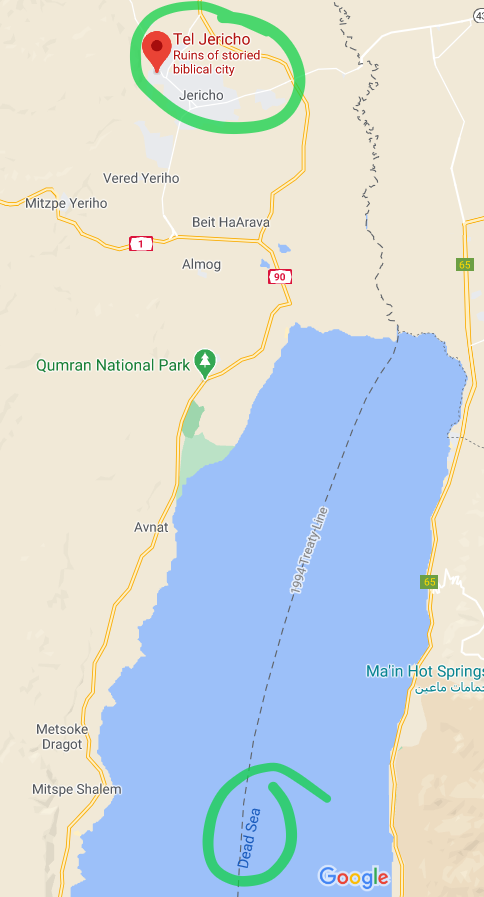
The Location of Jericho
Just like the Bible says, Jericho really is located near the Dead Sea. A simple Google Maps search will confirm this. The site of ancient Jericho is located adjacent to the Dead Sea and the ruins can still be visited today by the public. Modern Jericho is about two miles away from the ruin site.
Excavations of Jericho
Jericho was first excavated in the late 1860’s by Archaeologist Charles Warren. There were a number of successive archaeologists, and then in 1952, Archaeologist Kathleen Kenyon began her own six year excavation of Jericho. We will be looking primarily at her findings in this article, in order to showcase just a small portion of what she discovered while digging.
Was Jericho a Walled City?
In a 1954 article on Jericho for the Royal Anthropological Institute, Kenyon writes: “...it appears to have been surrounded by a wall, sure evidence of a developed community….The construction of such a wall argues a well organized community, and it is by far the earliest wall of this character known.” 2
By the time she writes another article for the magazine in 1967, she is firm in her discovery of a wall, and even has discovered that more than one wall had been built during the time of the city’s inhabitation, dating to different eras. 3
This can be seen in the drawing, taken from her 1967 article. The wall that would be congruent with the Biblical account of Jericho’s wall would be the one Kenyon dated to the Middle Bronze Age.

A Collapsing Wall & A Burned City
Kenyon writes about finding the collapsed wall and the houses from that time period being burnt. She speaks of the walls as being in “ruins” following their “destruction” 4. Archaeologist Garstang, who excavated Jericho in 1930 discovered that the walls were burned as well, prior to Kenyon’s dig.

Garstang also discovered storage jars that were filled with grain. Kenyon includes this information in her 1954 article and attributes the find to Garstang. 5
A siege to overtake a city could have lasted many months, and with all of the people locked inside with the gates closed, nobody coming in or out, food would have started to dwindle. Had there been a lengthy attack, the grain would have certainly been eaten at least to some degree. But the jars were full.

So, why didn’t the people who captured the city take the grain too? Why would they burn food that they could have eaten? From a general standpoint, it makes no sense. If the city had been plundered, it would seem to fall in line that the food would be taken as well, not burned.
However, if we reference back briefly to the Biblical narrative, we see that God had told the Israelites that everything in the city was to be destroyed (Joshua 6:17-18) and then the Bible tells us that they obeyed this command, burning everything in it (Joshua 6:24). If it was the Israelites who overtook the city, this grain being burned makes sense. It also makes sense why the wall and houses were burned.
So, Is the Bible Correct?
Archaeologists disagree on when exactly this wall was built and when it fell, with a discrepancy between them of about 150 years. It is also disputed among archaeologists on who exactly overtook the city. Was it the Egyptians? The Hyksos? The Israelites?
I will leave the areas of uncertainty to the reader to decide. To look more into the date discrepancies and who could have destroyed the city, I recommend this link. I found it highly informative, but did not include any of the content in this article due to the controversy behind the dating of the wall collapse and of who overtook the city.
The Bible is correct. There was (and still is) a city named Jericho located near the Dead Sea. The Bible was correct about the location. Jericho had a wall that fell quickly, the Bible was correct about it being a walled city, and correct that the wall fell in a short period of time. Everything in the city was burned. The Bible also is correct about that.
These are indisputable facts based off of archaeological findings, with no need for controversial conjecture. These truths are in line with both the Biblical narrative and archaeology. Facts are stubborn things.
Citations
Kenyon, Kathleen M. “Excavations at Jericho.” The Journal of the Royal Anthropological Institute of Great Britain and Ireland, vol. 84, no. 1/2, 1954, pp.103
Kenyon, Kathleen M. “JERICHO: Oldest Walled Town.” Archaeology, vol. 7, no. 1, 1954, pp. 3-4
KENYON, KATHLEEN M. “Jericho.” Archaeology, vol. 20, no. 4, 1967, pp. 269
KENYON, KATHLEEN M. “Jericho.” Archaeology, vol. 20, no. 4, 1967, pp. 274
Kenyon, Kathleen M. “JERICHO: Oldest Walled Town.” Archaeology, vol. 7, no. 1, 1954, pp. 7

Comments